
 日本語
 中文
 Deutsch
 Español
Solder Non-Wetting: Don’t Turn Up the Temperature [Steve’s Tech Article]
Table of Contents
- What Is Non-Wetting? — The Most Common Defect
- The Common Mistake — Raising the Temperature Is the Last Resort
- What Actually Causes It — ~38% Heat-Related, ~62% Workpiece Condition, Flux Deactivation, and Other
- Flux Before Solder — Flux Clears the Road First
- 350°C vs. 410°C — What Happens When You Raise the Temperature
- What to Check — Temperature Comes Last
- Summary
- Related Products & Services
- Video for This Tech Article
Video for this Tech Article
What Is Non-Wetting? — The Most Common Defect
S Hello everyone. I’m Steve, a soldering engineer at Japan Unix.
Today I want to talk about non-wetting, the most common defect in automated soldering. In our in-house records, non-wetting accounts for roughly half of all recorded defect modes.
The Common Mistake — Raising the Temperature Is the Last Resort
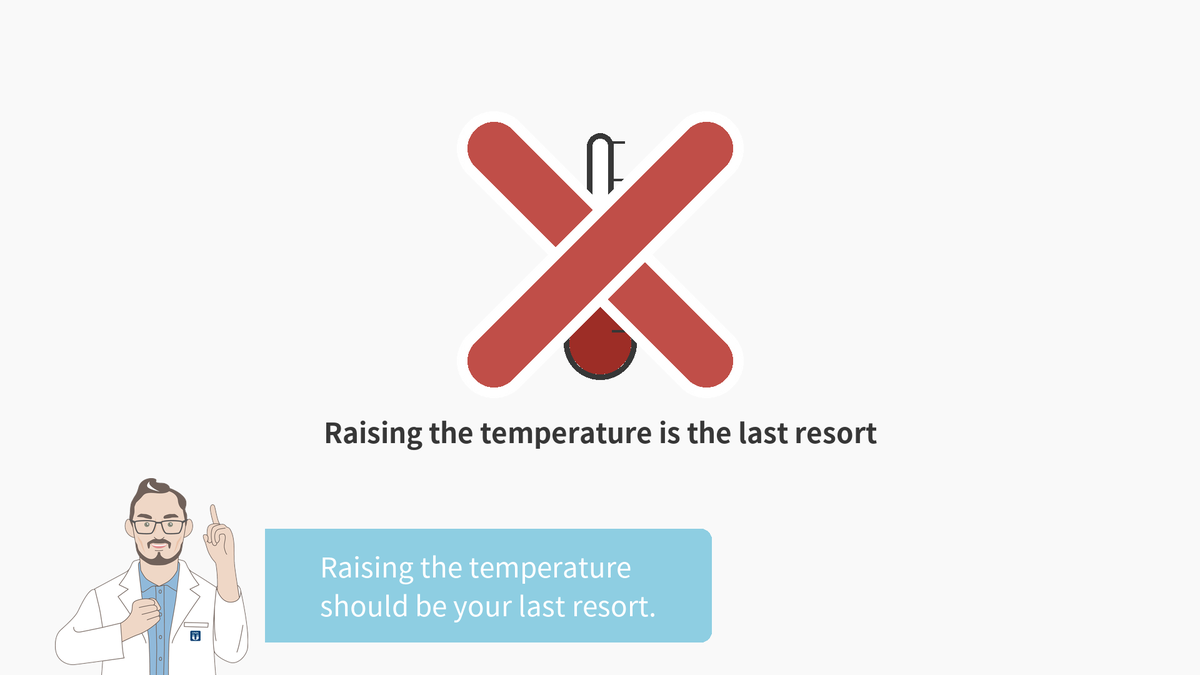
S When non-wetting shows up, the first thing you must not do is raise the temperature. Raising the temperature should be your last resort.
On the floor, “if it’s not wetting, raise the heat” is often the reflex fix — but that’s a coin flip at best. When it’s the wrong call, it doesn’t just fail to help; it can make things worse.
What Actually Causes It — ~38% Heat-Related, ~62% Workpiece Condition, Flux Deactivation, and Other
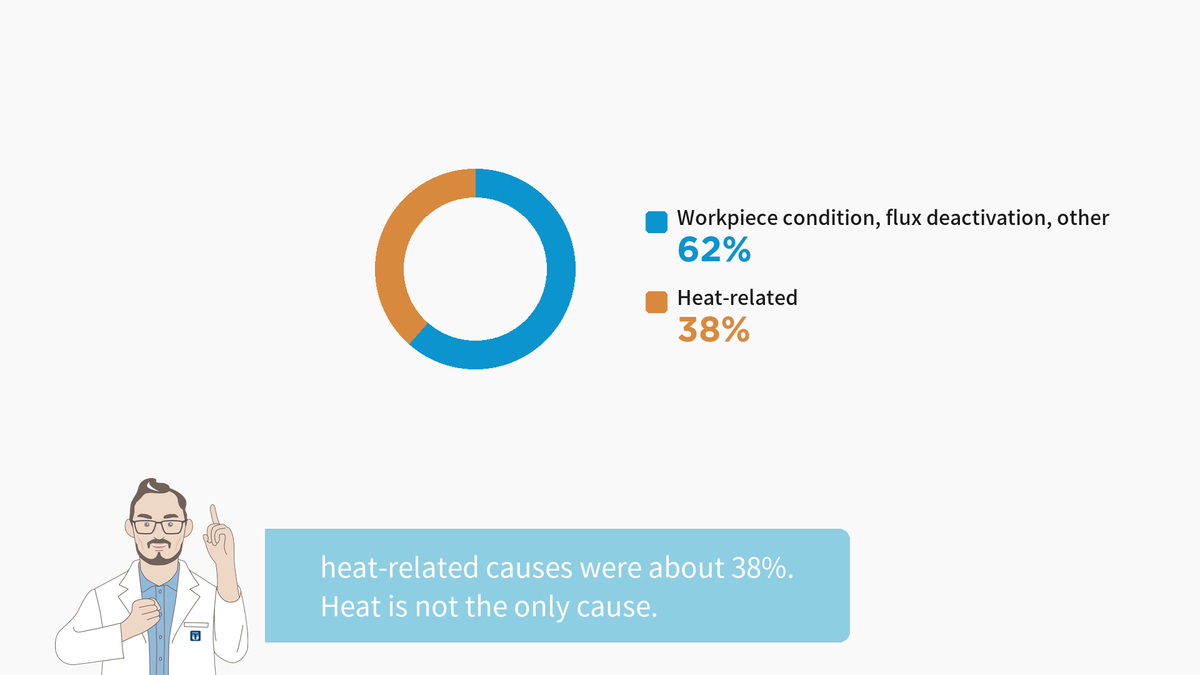
S When we actually counted the causes, workpiece condition, flux deactivation, and other factors made up about 62%, and heat-related causes were about 38%. Heat is not the only cause.
Heat-related causes are still nearly 4 in 10 — this isn’t “heat doesn’t matter.” But there’s no data-backed reason to reach for the temperature dial first while setting aside the roughly 6 in 10 causes that have nothing to do with heat.
| Non-Wetting Cause Category | Share |
|---|---|
| Workpiece condition, flux deactivation, other | ~62% |
| Heat-related (insufficient heat, heat capacity, position) | ~38% |
Flux Before Solder — Flux Clears the Road First
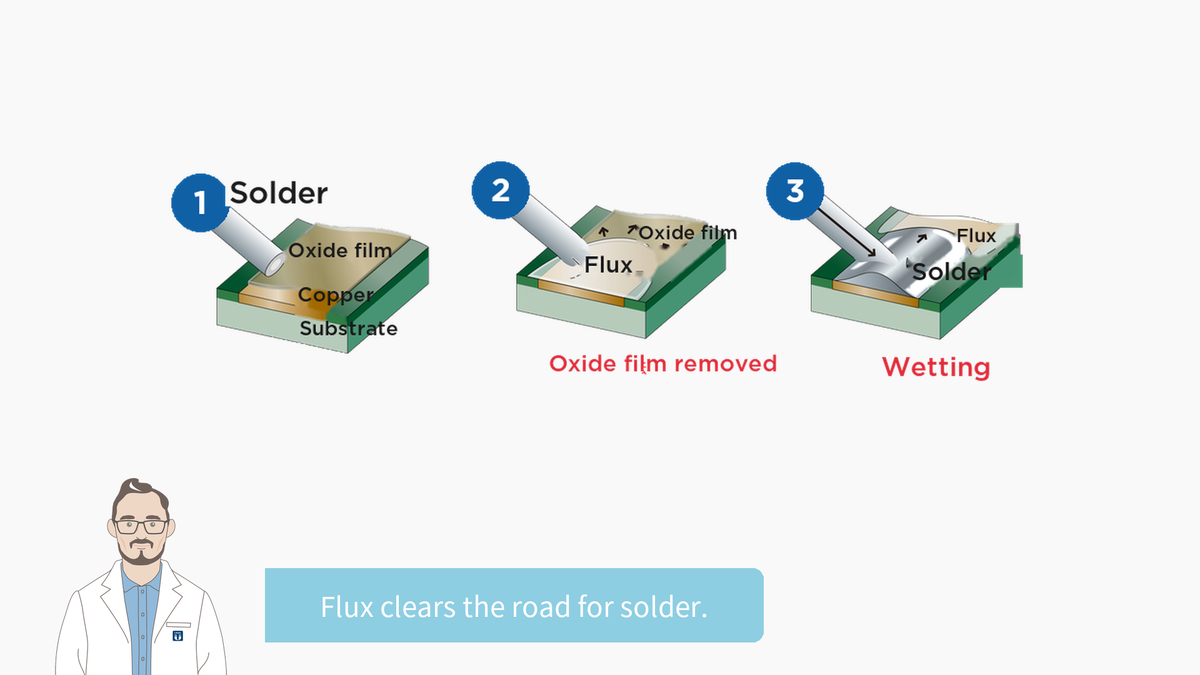
S Flux lives inside the solder wire. Flux melts at 80–120°C, and lead-free solder melts at 217°C.
Flux is lighter and melts first, flowing out ahead of the solder. So the correct order is: flux flows first and strips the oxide film, and the solder follows the path it clears — that’s the mechanism. Flux’s job is to clear the road for the solder that follows.
350°C vs. 410°C — What Happens When You Raise the Temperature
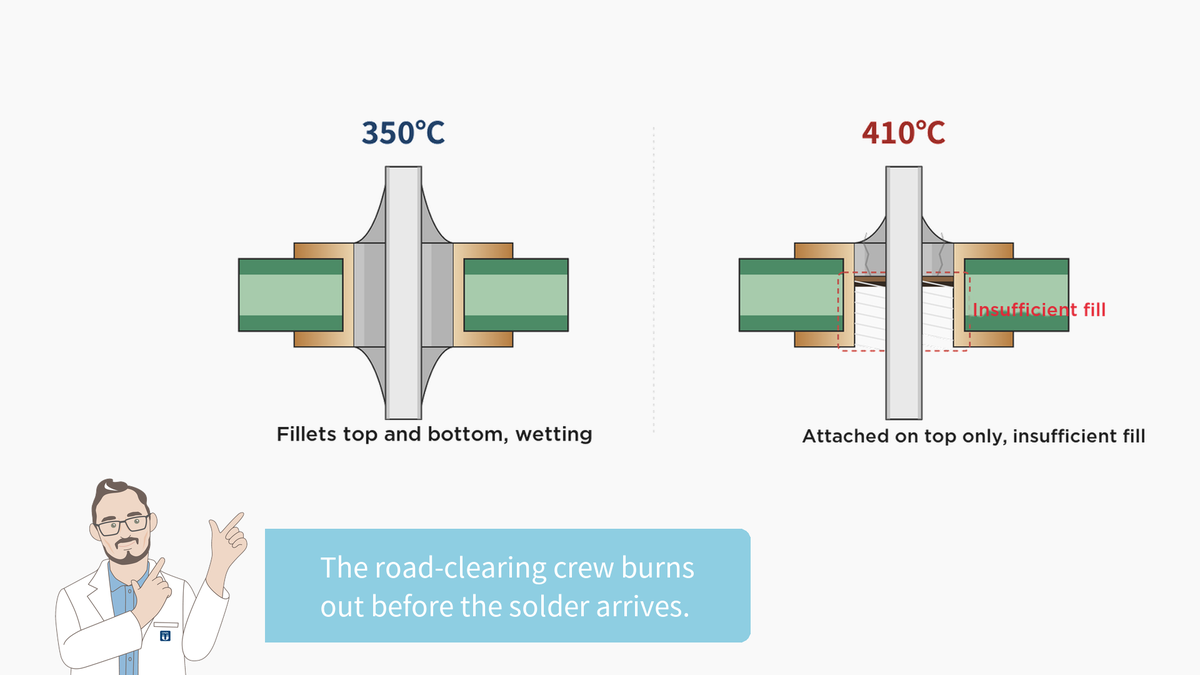
S When we actually compared 350°C and 410°C, the 410°C tip spread well at first, but it can deactivate partway through. The road-clearing crew — the flux — burns out before the solder arrives.
In other words, if the workpiece surface is the real cause of non-wetting, raising the temperature can burn off the very flux that would have cleaned that surface, before the solder gets its chance.
What to Check — Temperature Comes Last
S So let’s look at what to check first: contact time, contact position, how you measure temperature, the tip, solder material, and workpiece surface. Temperature is the last thing to check.
This is a suggested order for what to check first — not a set of steps for what to change. Whether and how you actually change any setting, condition, or material is a decision for you to make under your own change-management procedure.
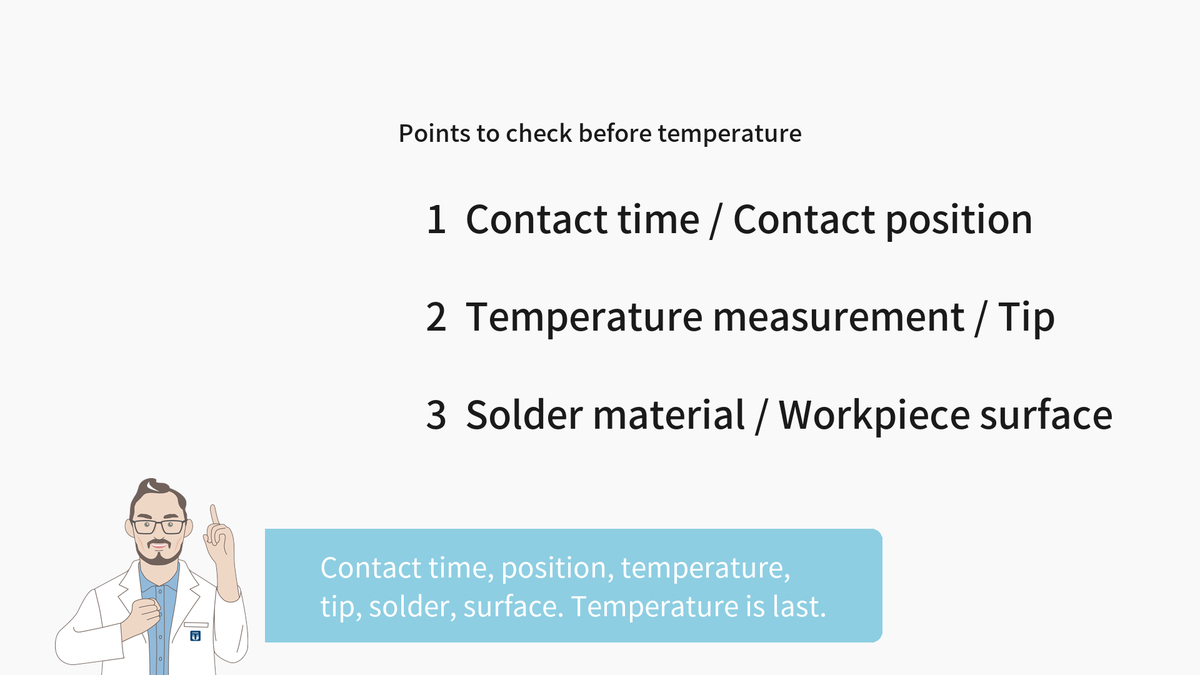
- Contact time — check whether the current setting matches the actual dwell time of the tip
- Contact position — check the fixture, workpiece lift or warp, and feed position for misalignment
- Temperature measurement — check the actual measured value, not the setpoint
- Tip condition — check for carbonized residue, oxidation, wetted surface, and cleaning state
- Solder material — check flux activity and properties such as halogen-free or high-viscosity formulations
- Workpiece surface — check for oxidation, contamination, and storage condition
- Only then, and only with high heat-capacity workpieces, does temperature become a relevant question — and temperature is an equipment setting, so whether to change it is your decision, made under your own change-management procedure (4M change control) and your own approval
Summary
- Non-wetting is the most common defect — but the cause isn’t always heat (heat-related is only about 38%)
- Raising the temperature can backfire by deactivating the flux before it does its job
- Check in this order: contact time → contact position → temperature measurement → tip → solder material → workpiece surface → temperature last
S Non-wetting is the most common defect. But the cause isn’t always heat. There are things worth checking before you consider the temperature.
When non-wetting appears in production: what to check before you raise the temperature, in one checklist.
The full checklist is in this one page. Soldering Defect Troubleshooting Checklist (2 pages, 31 items) — page 1 is the scan-and-check page for the floor, page 2 explains why each point is checked.
Download the Soldering Defect Troubleshooting Checklist (Free)
If you have other questions, feel free to reach out to Japan Unix.
Related Products & Services
Video for This Tech Article
Related document: Soldering Defect Troubleshooting Checklist (Free)
関連記事

Soldering Basics Installation Automation
Configuration of Soldering Robot [Steve’s Tech Article]